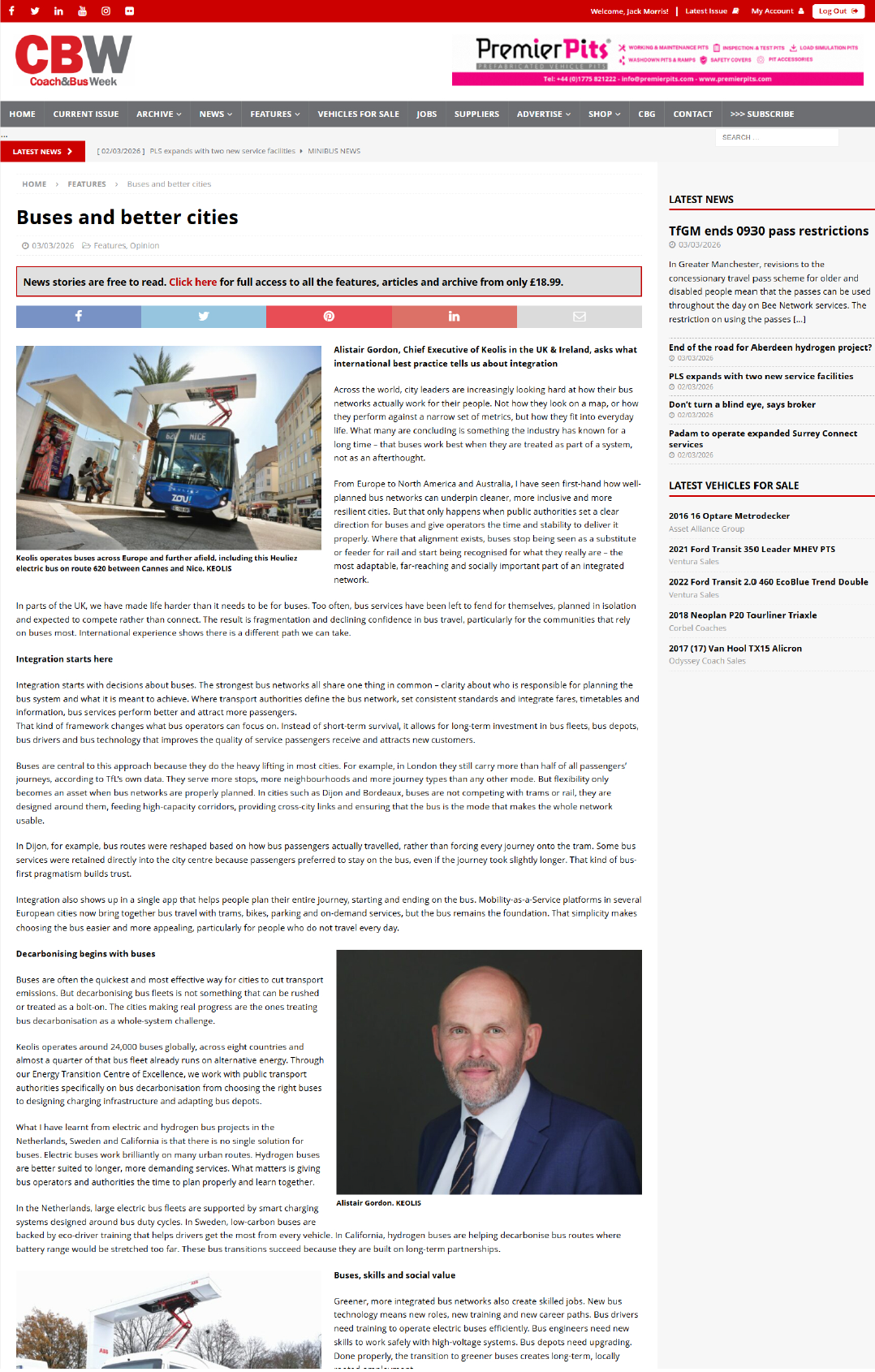
Alistair Gordon, Chief Executive of Keolis in the UK & Ireland, asks what international best practice tells us about integration
Across the world, city leaders are increasingly looking hard at how their bus networks actually work for their people. Not how they look on a map, or how they perform against a narrow set of metrics, but how they fit into everyday life. What many are concluding is something the industry has known for a long time – that buses work best when they are treated as part of a system, not as an afterthought.
From Europe to North America and Australia, I have seen first-hand how well planned bus networks can underpin cleaner, more inclusive and more resilient cities. But that only happens when public authorities set a clear direction for buses and give operators the time and stability to deliver it properly. Where that alignment exists, buses stop being seen as a substitute or feeder for rail and start being recognised for what they really are – the most adaptable, far-reaching and socially important part of an integrated network.
In parts of the UK, we have made life harder than it needs to be for buses. Too often, bus services have been left to fend for themselves, planned in isolation and expected to compete rather than connect. The result is fragmentation and declining confidence in bus travel, particularly for the communities that rely on buses most. International experience shows there is a different path we can take.
Integration starts here
Integration starts with decisions about buses. The strongest bus networks all share one thing in common – clarity about who is responsible for planning the bus system and what it is meant to achieve. Where transport authorities define the bus network, set consistent standards and integrate fares, timetables and information, bus services perform better and attract more passengers.
That kind of framework changes what bus operators can focus on. Instead of short-term survival, it allows for long-term investment in bus fleets, bus depots, bus drivers and bus technology that improves the quality of service passengers receive and attracts new customers.
Buses are central to this approach because they do the heavy lifting in most cities. For example, in London they still carry more than half of all passengers’ journeys, according to TfL’s own data. They serve more stops, more neighbourhoods and more journey types than any other mode. But flexibility only becomes an asset when bus networks are properly planned. In cities such as Dijon and Bordeaux, buses are not competing with trams or rail, they are designed around them, feeding high-capacity corridors, providing cross-city links and ensuring that the bus is the mode that makes the whole network usable.
In Dijon, for example, bus routes were reshaped based on how bus passengers actually travelled, rather than forcing every journey onto the tram. Some bus services were retained directly into the city centre because passengers preferred to stay on the bus, even if the journey took slightly longer. That kind of bus-first pragmatism builds trust.
Integration also shows up in a single app that helps people plan their entire journey, starting and ending on the bus. Mobility-as-a-Service platforms in several European cities now bring together bus travel with trams, bikes, parking and on-demand services, but the bus remains the foundation. That simplicity makes choosing the bus easier and more appealing, particularly for people who do not travel every day.
Decarbonising begins with buses
Buses are often the quickest and most effective way for cities to cut transport emissions. But decarbonising bus fleets is not something that can be rushed or treated as a bolt-on. The cities making real progress are the ones treating bus decarbonisation as a whole-system challenge.
Keolis operates around 24,000 buses globally, across eight countries and almost a quarter of that bus fleet already runs on alternative energy. Through our Energy Transition Centre of Excellence, we work with public transport authorities specifically on bus decarbonisation from choosing the right buses to designing charging infrastructure and adapting bus depots.
What I have learnt from electric and hydrogen bus projects in the Netherlands, Sweden and California is that there is no single solution for buses. Electric buses work brilliantly on many urban routes. Hydrogen buses are better suited to longer, more demanding services. What matters is giving bus operators and authorities the time to plan properly and learn together.
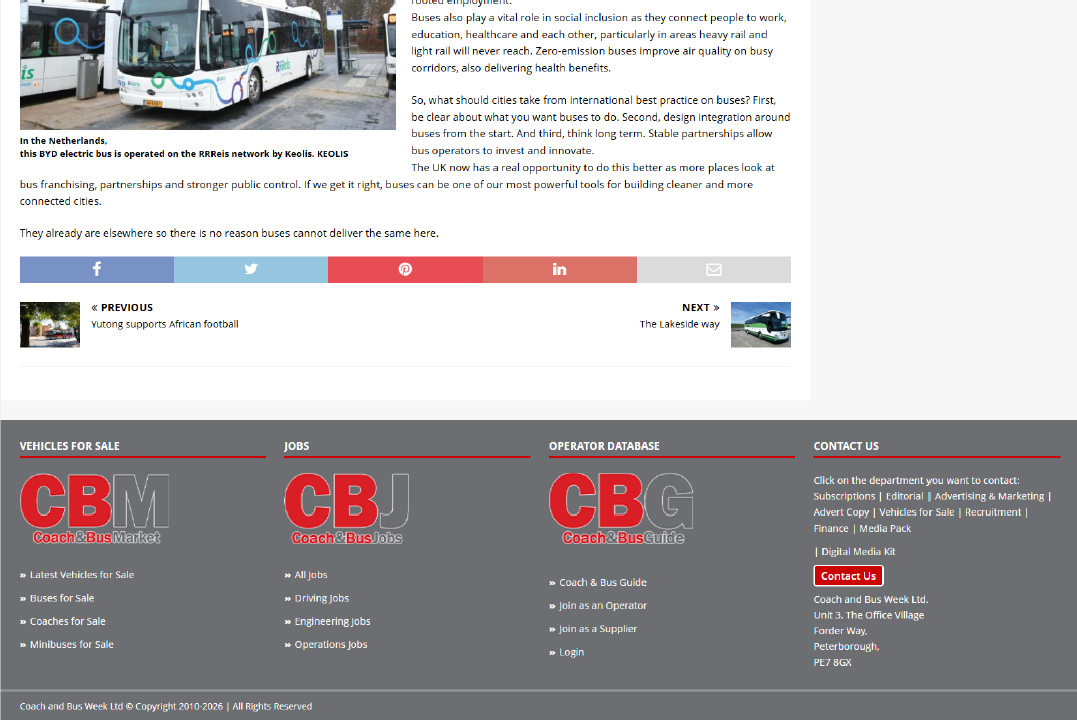
In the Netherlands, large electric bus fleets are supported by smart charging systems designed around bus duty cycles. In Sweden, low-carbon buses are backed by eco-driver training that helps drivers get the most from every vehicle. In California, hydrogen buses are helping decarbonise bus routes where battery range would be stretched too far. These bus transitions succeed because they are built on long-term partnerships.
Buses, skills and social value
Greener, more integrated bus networks also create skilled jobs. New bus technology means new roles, new training and new career paths. Bus drivers need training to operate electric buses efficiently. Bus engineers need new skills to work safely with high-voltage systems. Bus depots need upgrading. Done properly, the transition to greener buses creates long-term, locally rooted employment.
Buses also play a vital role in social inclusion as they connect people to work, education, healthcare and each other, particularly in areas heavy rail and light rail will never reach. Zero-emission buses improve air quality on busy corridors, also delivering health benefits.
So, what should cities take from international best practice on buses? First, be clear about what you want buses to do. Second, design integration around buses from the start. And third, think long term. Stable partnerships allow bus operators to invest and innovate.
The UK now has a real opportunity to do this better as more places look at bus franchising, partnerships and stronger public control. If we get it right, buses can be one of our most powerful tools for building cleaner and more connected cities.
They already are elsewhere so there is no reason buses cannot deliver the same here.