As the UK approaches the 20th anniversary of the UK Light Rail Conference this June, Britain’s premier event dedicated to advancing the sector, the role of light rail as critical national infrastructure is firmly in focus.
Britain’s transport debate has, for much of the past decade, oscillated between rail reform and bus franchising. Yet an increasingly urgent question sits between the two – how to build high-capacity, low-carbon urban systems that can shape growth rather than merely respond to it.
Too often the answer has been to default to buses, a flexible but somewhat limited solution when cities need long-term, high-capacity infrastructure.
Light rail – long treated as a secondary mode – is now re-emerging as a strategic necessity. It is not simply an alternative to buses but a fundamentally different proposition that provides the permanence, capacity and certainty growing cities require.
The case for a coordinating national body – “Great British Light Rail” (GBLR) – rests on a simple proposition that the UK has the demand, capability and precedent, but lacks the institutional framework to deliver at scale.
The argument is not that Britain should build more tramways in isolation, it is that light rail must be embedded at the centre of integrated
urban transport systems, supported by consistent policy, long-term funding and clear governance. Without that, progress will remain
fragmented, dependent on local political cycles and vulnerable to shifting national priorities.
From niche to necessity
Light rail has often been framed in the UK as desirable where affordable, but not essential. That framing no longer holds with urbanisation and decarbonisation placing new demands on transport systems that buses and heavy rail alone cannot meet.
International experience is instructive. In cities across Europe, trams are not an add-on but the backbone of multi-modal networks, linking metro systems, buses and active travel into a coherent whole.
The underlying economics are equally important. Light rail corridors concentrate demand, support higher-density development and provide the permanence that underpins investor confidence. Unlike bus routes, which can be reconfigured or withdrawn, fixed rail
infrastructure sends a clear, long-term message to investors and communities.
In practice, this translates into faster regeneration cycles and more predictable land value uplift. As cities grow denser, such fixed,
high-capacity systems become less a luxury than a prerequisite for sustainable expansion.
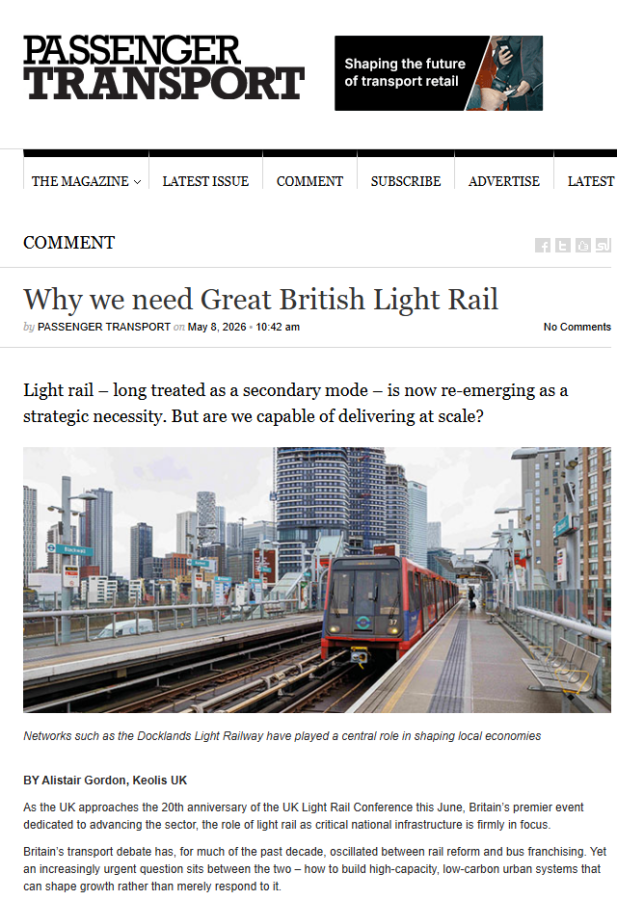
Britain has already seen this dynamic at work. Networks such as Manchester Metrolink, Nottingham Express Transit and the Docklands Light Railway collectively carry a substantial share of the UK’s light rail passengers and have played a central role in shaping local economies. Their success is not incidental but reflects the alignment of transport planning with wider economic strategy.
The integration gap
The case for GBLR rests on the system-level barriers that continue to constrain delivery and chief among these is fragmentation.
Transport in the UK remains divided across modes, funding streams and governance structures. While devolution has empowered city regions, it has also produced a patchwork of approaches, with varying levels of capability and resource with the result being inconsistency in planning, procurement and delivery.
This matters because light rail is inherently a whole-system intervention. Its value depends on integration with bus networks, with ticketing systems, with land-use planning and with emerging mobility platforms. Where integration is weak, the benefits are diluted.
Evidence from integrated networks elsewhere underscores the point. In cities such as Dijon and Bordeaux, tram systems are designed
alongside bus routes, fare structures and digital platforms, enabling seamless journeys across modes. Mobility-as-a-Service tools further unify the system, allowing passengers to plan, book and pay across the entire network.
By contrast, the UK has often struggled to align these elements. Bus services, in particular, have historically been planned in isolation in many areas, limiting their ability to act as effective feeders to high-capacity corridors. The consequence is a sub-optimal network, where each mode performs below its potential.
The case for a guiding mind
Here GBLR would be a coordinating force, its purpose would be to provide strategic clarity while preserving local delivery.
A key function would be to help with longterm planning. A rolling pipeline of projects would provide certainty to supply chains, investors and local authorities, enabling more efficient procurement and reducing costs over time. Infrastructure of this scale cannot be delivered on a stop-start basis without incurring significant inefficiencies.
Second, funding stability. Light rail schemes are capital-intensive, with long payback periods. Short-term funding cycles, tied to political timetables, are poorly suited to such investments. A national body could help structure funding over decades, including the use of value capture mechanisms and local revenue tools.
Third, standardisation and expertise. The UK has developed considerable capability in light rail, but this expertise is dispersed. A central body could codify best practice, support local authorities and reduce duplication of effort. This is particularly relevant for emerging technologies such as very light rail, where regulatory frameworks are still evolving.
Fourth, integration with national policy. Light rail sits at the intersection of transport, housing and economic development. A national body could ensure that schemes are assessed against broader public value criteria.
Learning from what works
The UK does not need to look far for evidence of what effective light rail can achieve. Manchester offers perhaps the most developed example. Metrolink’s expansion has been closely aligned with the city’s wider economic strategy, supporting growth corridors and enabling the development of the Bee Network – an integrated system combining trams, buses and active travel. This alignment has driven both ridership growth and wider economic benefits.
The Docklands Light Railway provides a different, but equally instructive model. Its role in the regeneration of East London is well documented, with sustained investment in capacity and service quality supporting rapid population and employment growth. Continued enhancements, including new rolling stock and service upgrades, are designed to keep pace with rising demand.
These systems succeed because they are planned and operated as part of a wider network, not as standalone assets. The same principles are now being applied in West Yorkshire, where plans for a new tram system reflect a growing recognition that light rail must sit at the heart of integrated regional transport from the outset.
The role of international experience
Britain’s challenge is not unique as cities worldwide are grappling with similar pressures of growth, decarbonisation and congestion. The difference lies in how they respond.
Keolis’ international operations provide a useful lens. Across Europe, the Middle East and Australia, tram and metro systems are increasingly designed as part of integrated mobility ecosystems, supported by digital platforms, coordinated timetables and unified
ticketing.
These systems also benefit from institutional continuity. Long-term partnerships between operators and public authorities enable sustained investment in infrastructure, technology and skills. Centres of excellence and knowledge-sharing networks ensure that lessons are captured and applied across projects.
For the UK, the implication is clear. The technical capability exists, both domestically and internationally, but what is missing is a mechanism to apply it consistently. Beyond infrastructure The case for GBLR extends beyond transport outcomes but is also about environmental policy and social inclusion.
Light rail supports decarbonisation by shifting journeys from private cars to electrified public transport. It improves air quality and reduces congestion, particularly in dense urban areas where road capacity is constrained. It also underpins labour market efficiency, connecting people to jobs, education and services. This is particularly important in regional cities, where transport constraints can limit economic potential.
Finally, it creates skilled employment. The development, operation and maintenance of light rail systems require a range of technical and operational skills, supporting long-term job creation and capability building.
A question of ambition
The UK’s recent policy direction towards greater integration, devolution and decarbonisation is broadly aligned with the case for light rail. Bus franchising, in particular, reflects a growing recognition that transport systems perform better when planned as a whole, but continuing to rely on bus-led solutions alone will not be enough to meet the demands of growing cities.
Yet without a mechanism to coordinate investment and planning, the risk is that light rail continues to develop in pockets, rather than as a coherent national network.
GBLR offers a way to address this. It would not remove the role of local authorities or operators but it would provide the framework within which they can operate more effectively.
Without it, progress risks remaining fragmented, unlikely to meet the demands of growing cities and net zero targets.
ABOUT THE AUTHOR
Alistair Gordon is CEO of Keolis UK, Ireland, Middle East, and India. He has been CEO of Keolis UK since 2010, having joined Keolis in 2004