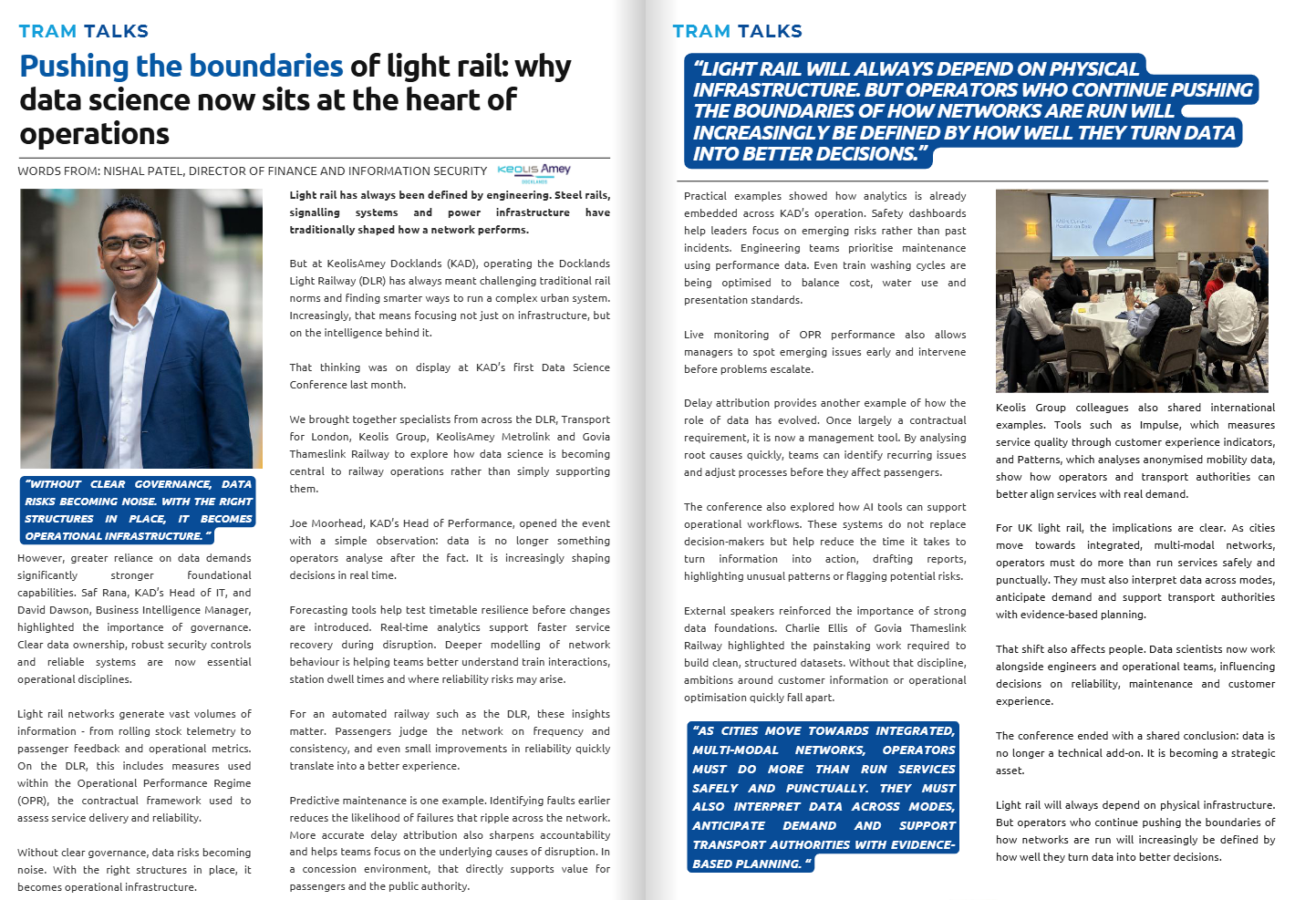
Nishal Patel, Director of Finance and Information Security, KeolisAmey Docklands
Light rail has always been defined by engineering. Steel rails, signalling systems and power infrastructure have traditionally shaped how a network performs.
But at KeolisAmey Docklands (KAD), operating the Docklands Light Railway (DLR) has always meant challenging traditional rail norms and finding smarter ways to run a complex urban system. Increasingly, that means focusing not just on infrastructure, but on the intelligence behind it.
That thinking was on display at KAD’s first Data Science Conference last month.
We brought together specialists from across the DLR, Transport for London, Keolis Group, KeolisAmey Metrolink and Govia Thameslink Railway to explore how data science is becoming central to railway operations rather than simply supporting them.
Joe Moorhead, KAD’s Head of Performance, opened the event with a simple observation: data is no longer something operators analyse after the fact. It is increasingly shaping decisions in real time.
Forecasting tools help test timetable resilience before changes are introduced. Real-time analytics support faster service recovery during disruption. Deeper modelling of network behaviour is helping teams better understand train interactions, station dwell times and where reliability risks may arise.
For an automated railway such as the DLR, these insights matter. Passengers judge the network on frequency and consistency, and even small improvements in reliability quickly translate into a better experience.
Predictive maintenance is one example. Identifying faults earlier reduces the likelihood of failures that ripple across the network. More accurate delay attribution also sharpens accountability and helps teams focus on the underlying causes of disruption. In a concession environment, that directly supports value for passengers and the public authority.
However, greater reliance on data demands significantly stronger foundational capabilities. Saf Rana, KAD’s Head of IT, and David Dawson, Business Intelligence Manager, highlighted the importance of governance. Clear data ownership, robust security controls and reliable systems are now essential operational disciplines.
Light rail networks generate vast volumes of information – from rolling stock telemetry to passenger feedback and operational metrics. On the DLR, this includes measures used within the Operational Performance Regime (OPR), the contractual framework used to assess service delivery and reliability.
Without clear governance, data risks becoming noise. With the right structures in place, it becomes operational infrastructure.
Practical examples showed how analytics is already embedded across KAD’s operation. Safety dashboards help leaders focus on emerging risks rather than past incidents. Engineering teams prioritise maintenance using performance data. Even train washing cycles are being optimised to balance cost, water use and presentation standards.
Live monitoring of OPR performance also allows managers to spot emerging issues early and intervene before problems escalate.
Delay attribution provides another example of how the role of data has evolved. Once largely a contractual requirement, it is now a management tool. By analysing root causes quickly, teams can identify recurring issues and adjust processes before they affect passengers.
The conference also explored how AI tools can support operational workflows. These systems do not replace decision-makers but help reduce the time it takes to turn information into action, drafting reports, highlighting unusual patterns or flagging potential risks.
External speakers reinforced the importance of strong data foundations. Charlie Ellis of Govia Thameslink Railway highlighted the painstaking work required to build clean, structured datasets. Without that discipline, ambitions around customer information or operational optimisation quickly fall apart.
Keolis Group colleagues also shared international examples. Tools such as Impulse, which measures service quality through customer experience indicators, and Patterns, which analyses anonymised mobility data, show how operators and transport authorities can better align services with real demand.
For UK light rail, the implications are clear. As cities move towards integrated, multi-modal networks, operators must do more than run services safely and punctually. They must also interpret data across modes, anticipate demand and support transport authorities with evidence-based planning.
That shift also affects people. Data scientists now work alongside engineers and operational teams, influencing decisions on reliability, maintenance and customer experience.
The conference ended with a shared conclusion: data is no longer a technical add-on. It is becoming a strategic asset.
Light rail will always depend on physical infrastructure. But operators who continue pushing the boundaries of how networks are run will increasingly be defined by how well they turn data into better decisions.